
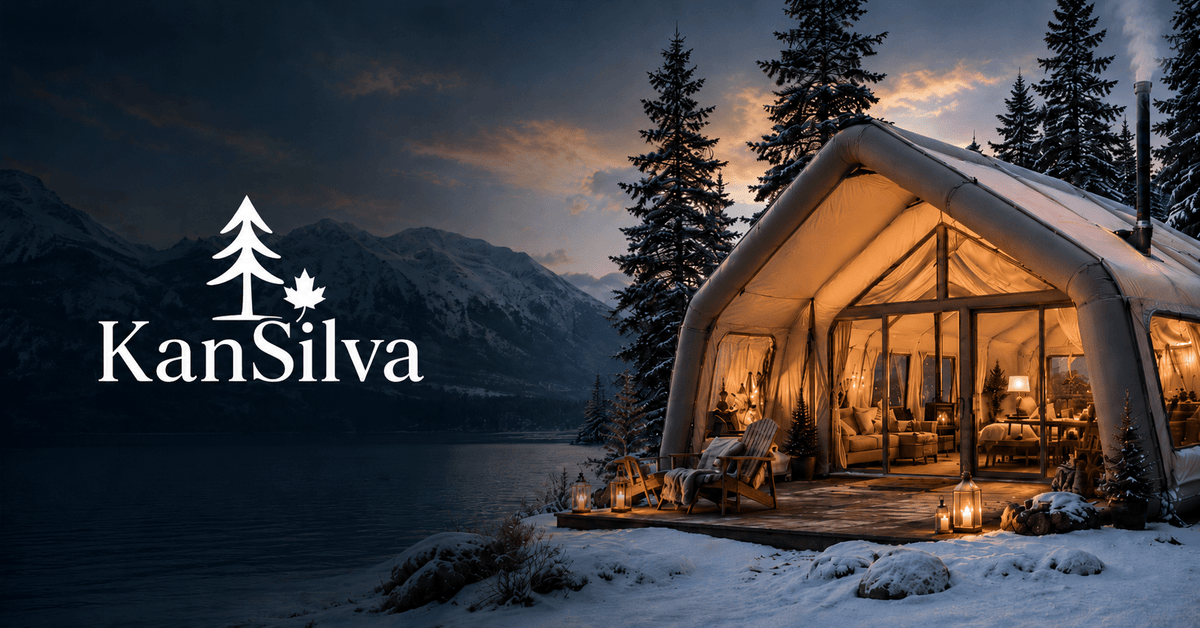
KanSilva: Our Vision of Glamping in Canada
When we first started thinking about KanSilva, the idea wasn't just to create another tent brand.
There are already a huge number of camping tents out there. Some are very lightweight, others are designed for expeditions, and still others focus primarily on price.
What interested us instead was this in-between space: the feeling of truly being in nature, but without necessarily having to sleep on all fours in a small tent with all your gear piled around you.
That's pretty much how our vision of glamping developed.
We love camping. We love fires, lakes, forests, and being able to set up camp almost anywhere. But we also believe it's possible to make this experience much more comfortable without taking away what makes it so appealing.
Ultimately, KanSilva is mainly about creating spaces where you want to stay.
A brand designed around our Canadian reality
Camping in Canada isn't quite the same as camping in a climate where it's 20 degrees almost all year round.
Here, you can have a beautiful day in September and then wake up a few hours later to temperatures close to freezing.
We get rain.
Wind.
Cold springs.
Autumns that can be incredible, but quickly turn chilly as soon as the sun disappears.
And of course, we have winter.
This reality heavily influences how we think about our products.
KanSilva develops glamping tents designed for various uses, whether it's for four-season camping, tourism, rental, nature accommodation, or even certain winter activities.
That doesn't mean a tent magically becomes a cabin just because it's large or you can install a stove in it.
It mainly means we try to consider how people will actually use it here.
For us, glamping isn't a hotel in the forest
The word glamping can sometimes conjure up a very particular image.
One might imagine a huge, perfectly decorated white tent, an outdoor bathtub, and a five-star hotel bed placed in the middle of nowhere.
That's one way to go glamping, but it's not necessarily the one that interests us most.
Our vision is much simpler.
We want to be able to enter our tent without constantly bending over.
To be able to sit comfortably when it rains.
To have coffee in the morning without feeling like the whole camp is crammed into two square meters.
To be able to cook.
To set up a proper sleeping area.
To spend a few days in the same place and feel like you've created your own little camp.
For us, comfort isn't there to distance us from nature.
Instead, it allows us to stay there longer.
Why inflatable tents?
The first time you see a large inflatable tent, you might wonder why replace poles with air.
The answer becomes quite obvious when you start pitching large tents.
The bulkier they get, the longer, heavier, and more complicated rigid structures can be to assemble.
With an inflatable structure, much of that work disappears.
On our Hans Sovereignty, for example, the main columns are inflatable. The tent offers about 11 m² of interior space with a maximum height of about 235 cm. Inflating the structure typically takes around four to five minutes.
Of course, that doesn't mean the entire campsite is ready in five minutes.
You still need to properly position the tent, anchor it, set up the guy lines, and then furnish the interior.
But the structure itself becomes much easier to understand.
And that's something we really like about the product.
Hans Sovereignty, our starting point
The Hans Sovereignty is probably the product that best represents KanSilva today.
It's also the model around which much of our identity has been built.
Its name comes from Hans Island in the Arctic, a tiny territory long disputed between Canada and Denmark.
The story became famous partly due to the notorious "Whisky War," where Canadians and Danes would visit the island, leaving behind their flag and a bottle of alcohol.
We found the story so Canadian in its Nordic and almost absurdly friendly aspect that it seemed perfect for a tent.
Even its red color fully embraces this identity.
We didn't necessarily want to create a tent that blends into the landscape.
We wanted something recognizable.
A large tent also implies certain compromises
The Hans Sovereignty weighs approximately 50 kg.
So no, it's definitely not a tent we recommend for a multi-day hike with all your gear on your back.
And we prefer to be very clear about that.
This tent is designed more for vehicle-accessible locations, private land, extended stays, glamping setups, or places where it's relatively easy to bring your equipment.
In exchange, you get significantly more interior space than with a traditional tent.
It's a choice.
We sacrifice lightness for volume, comfort, and an experience that's closer to a small outdoor room.
And for the type of use we're targeting, this compromise seems logical to us.
The famous term "four-season"
It's probably one of the most misunderstood expressions in the world of camping.
A tent can be made with materials that tolerate very low temperatures, but that doesn't automatically mean a person will be comfortable inside at -30°C.
There are a huge number of variables.
Wind.
The type of heating.
The ground.
Bedding.
Humidity.
Ventilation.
The number of openings.
How the tent is set up.
Even the number of people inside can change the situation.
That's why we try to avoid spectacular promises like "you'll be comfortable at this temperature."
That would be far too simplistic.
What we aim to do instead is develop tents that can be used for a much longer period of the year when properly set up and equipped.
High-end without becoming inaccessible
We want KanSilva to be perceived as a high-end brand.
But we don't believe that being high-end simply means putting an extremely high price tag on a product.
For us, it's much more about the details.
The quality of materials.
The appearance of the product.
Service.
Accessories.
How issues are resolved when they arise.
Brand consistency.
And, over time, the reputation built around the products.
So we try to stay in what we might call an accessible luxury zone.
The Hans Sovereignty currently sells for around $2,500 CAD.
It obviously remains a significant purchase.
But when comparing this type of large inflatable tent to several high-end products available on the international market, we believe there's a place to offer something very interesting without necessarily reaching prices of $5,000, $6,000, or more.
And where are our tents made?
This is a question we prefer to address directly.
KanSilva is a Canadian company and our products are developed here.
However, a significant portion of their manufacturing is currently carried out abroad by specialized manufacturers.
Why?
Mainly because producing complex technical textile structures in very small quantities in Canada remains extremely difficult and costly for a young company.
We could simply avoid talking about this part.
But we prefer to be transparent.
Our long-term goal is to progressively increase the amount of work done in Canada.
That could involve assembly.
Sewing.
Repairs.
Manufacturing certain components.
Prototypes.
Finishing.
Testing.
We are already working in this direction and are actively seeking to develop more manufacturing expertise in Quebec.
So we don't claim that everything is made here today.
We simply want to be able to do more and more here over time.
We don't just want to sell a tent
This is probably one of the things that best explains where we want to go with KanSilva.
A large, completely empty tent is interesting.
But once you start using it for several days, it's often all the small surrounding elements that truly change the experience.
Where do you sit?
Where do you prepare meals?
How do you heat the space?
Where do you store things?
That's why we also develop accessories around our tents.
MallowPod
The MallowPod is probably the simplest accessory to understand.
It's essentially our way of having a real sofa at the campsite without having to carry a real sofa.
It's a two-person inflatable sofa made with durable Oxford fabric and equipped with its own rechargeable pump.
In a few minutes, you have something you can actually settle into to read, chat, or simply wait for the rain to pass.
It seems almost trivial.
But when you spend several days in the same place, having a comfortable spot to sit dramatically changes the experience.
Brookstone
The Brookstone comes from another classic camping frustration.
The kitchen.
You often end up with a stove on a table, a water bin on the ground, dishes in another bin, and food somewhere in between.
The Brookstone tries to make all that a little more logical.
It's a folding aluminum table that includes a water system with a spigot.
The idea is to create a small portable kitchen counter.
Not something luxurious just for the sake of looking luxurious.
Something that genuinely makes the campsite more pleasant to use.
Edziza
The Edziza is probably the accessory that best represents our Canadian side.
It's a foldable wood stove made of 304 stainless steel that can be used for heating, cooking, or simply boiling water.
It weighs approximately 17 kg and is designed to be used with compatible installations in our range.
Its name comes from Mount Edziza in British Columbia, a rather spectacular volcanic region.
We could hardly find a better name for a wood stove.
Names are part of the fun
This is something we really like about KanSilva.
We could easily call our models KS-01, KS-02, and KS-03.
It would be efficient.
But not very interesting.
We prefer each product to have a personality.
Hans Sovereignty comes from the Arctic.
Edziza comes from British Columbia.
Other models like Kamloops, Banff, and Thunder Cove are also among the products we are developing.
Canada is vast, and we probably have enough cities, mountains, lakes, and stories to name products for a very long time.
But we try not to fall into clichés.
The idea isn't to put a maple leaf everywhere.
We simply want the Canadian identity to be naturally present.
There isn't just one way to use a tent
That's probably what we find most interesting since developing KanSilva.
Two people can buy the exact same tent and do something completely different with it.
A family might use it a few weekends a year.
Someone might set it up on their property for several weeks.
A fisherman might want to create a more comfortable winter camp.
A landowner might make it a small refuge near a lake.
A tourism business might use it as an accommodation unit.
Someone might even develop a glamping rental project around it.
And often, these uses give us ideas we hadn't thought of initially.
That's also why we like to talk directly with our customers.
Being a young company also has its advantages
KanSilva is young.
And contrary to what one might think, we're not really trying to hide that reality.
Obviously, that means we don't yet have decades of history behind us.
But it also means decisions are made quickly.
If several people tell us a detail should be improved, we can actually look at how to modify it.
If someone uses a product in a way we never thought of, it can give us an idea for the future.
Even the people involved in manufacturing can have a direct influence on product improvements.
We find that much more interesting than simply producing the exact same product for ten years.
Our first customers are a little part of this story
That's also the idea behind our Ambassador program.
The first people who choose KanSilva join at a time when the brand is still being built.
Their feedback is therefore much more valuable to us than it might be in a company that already sells hundreds of thousands of products each year.
That doesn't mean we'll integrate every idea we receive.
Some are contradictory.
Some are very specific to a particular use.
But they allow us to understand how the products truly live once they leave our hands.
And no technical sheet can really teach us that.
And since we're talking about what's next... perhaps we can share a little secret with you
Glamping remains at the heart of KanSilva, but it's not the only world we're exploring.
We are currently working, quite discreetly, on something very different.
Sneak peek: KanSilva is structuring a new range of inflatable tents for events, designed around ultra-personalization.
The idea is to go much further than simply choosing a color or adding a logo.
We're talking about tents that could be developed around the identity of a company, an event, an organization, or even a creator: colors, graphics, visual details, dimensions, and certain design elements could be adapted directly to the project.
In short, something closer to a custom-made event space than a traditional tent.
We can't show everything yet.
Let's just say that the first concepts are under development, and we're very excited to see how far this idea can go.
For now, let's keep it between us.
Where do we want to go with KanSilva?
We have a lot of ideas.
Probably too many.
More tents.
More accessories.
Products for tourism professionals.
Potentially more customization.
More manufacturing and assembly in Canada.
And most importantly, a range that becomes increasingly cohesive over time.
But we don't want to launch everything at once.
We prefer to develop gradually.
Test.
Correct.
Listen.
Then move on to the next product.
KanSilva is therefore not yet a huge outdoor brand with fifty years of history.
And that's okay.
For now, we're building this story product by product.
The Hans Sovereignty is one of its first major chapters.
MallowPod, Brookstone, and Edziza are starting to create the surrounding environment.
And what's next is already under development.
Our ultimate goal remains quite simple: to create products that make people want to spend more time outdoors.
Even when it's a little cold.
Even when it's raining.
Even when you would normally have started thinking it's time to go home.
If we succeed in that, KanSilva will have already accomplished a good part of what we initially set out to do.